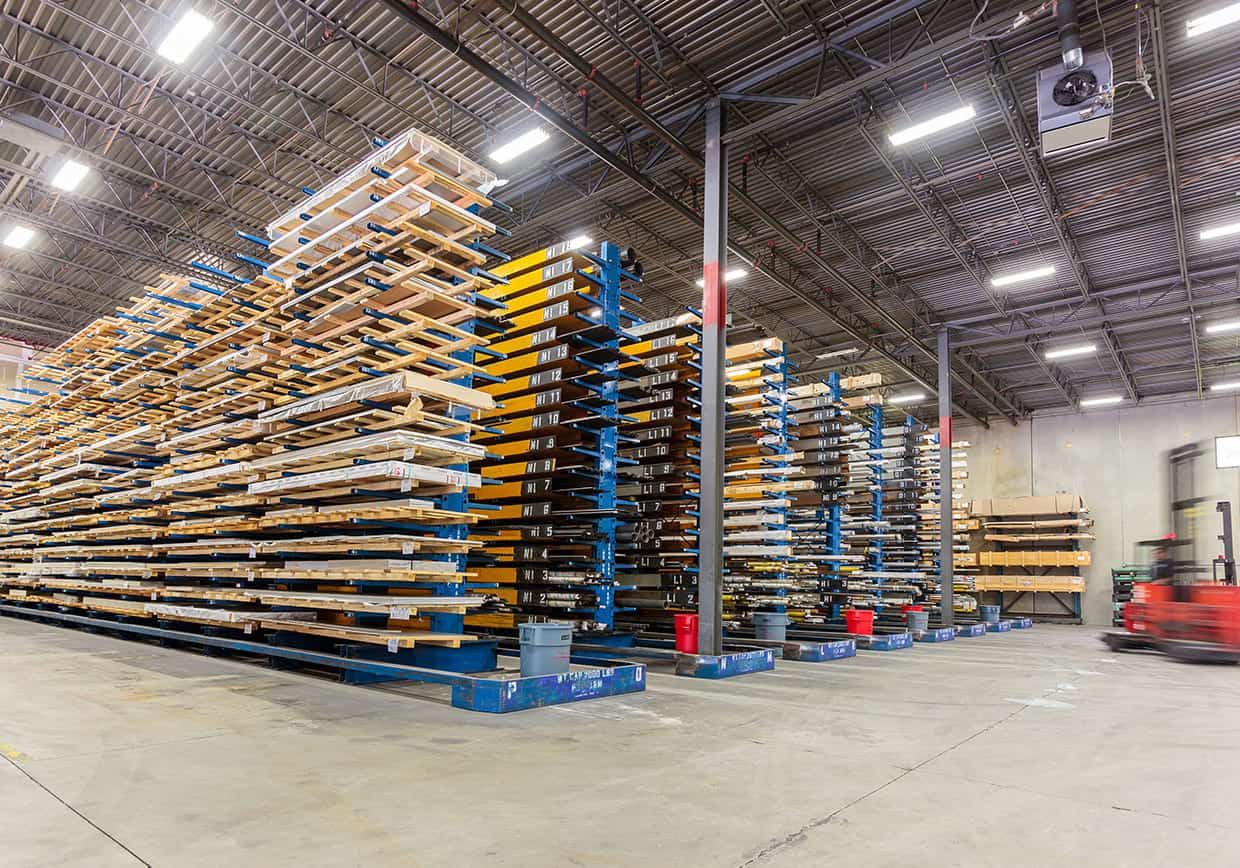
Pallet rack compliance is not a one-time checkbox. For Texas warehouse managers, meeting OSHA’s warehouse shelving safety standards is an ongoing responsibility that touches installation quality, daily operations, employee training, and documentation. This guide covers the OSHA regulations that apply to your facility, what the agency’s inspectors are looking for right now, and how to build a rack program that holds up under scrutiny.
Why OSHA Rack Compliance Is a Higher-Stakes Issue Right Now for Texas Warehouses
In July 2023, OSHA launched its National Emphasis Program (NEP) for Warehousing and Distribution Center Operations. The program runs through July 2026 and has significantly increased the frequency of both scheduled and unannounced inspections at warehouses across the country, including Texas.
Because Texas operates under federal OSHA rather than a state-run plan, facilities here are subject to full NEP enforcement with no local carve-outs. That means your risk exposure today is higher than it was two years ago, even if nothing at your facility has changed.
The NEP targets several areas directly tied to rack systems: material handling and storage, powered industrial vehicles, walking and working surfaces, and fire egress. Warehouse shelving safety standards fall squarely within these focus areas. Any of these categories can draw an inspector onto your floor. Once a violation is found, the scope of the inspection can expand to cover your entire facility. A single damaged upright or a missing load placard can open the door to a comprehensive review.
Texas also presents structural challenges that other states do not. Hurricanes, tornadoes, and high-wind events create forces that amplify the consequences of under-anchored rack systems. Managers in Texas need to treat anchoring requirements as a weather risk, not just a code requirement.
From a business standpoint, the stakes are significant: OSHA citations, work stoppages in hazardous areas, and increased liability exposure if an incident occurs on an out-of-compliance floor.
Understanding the OSHA Regulatory Framework for Warehouse Shelving Safety Standards
There is no single, dedicated OSHA standard for pallet racks. That may sound like good news, but pallet rack safety regulations are actually more complex because of it, not less. Without a single clear rule to follow, facilities are responsible for meeting multiple overlapping requirements, and inspectors have broad authority to cite violations across several frameworks.
OSHA enforces warehouse shelving safety standards through a combination of the General Duty Clause (Section 5(a)(1) of the OSH Act of 1970) and specific CFR standards:
- 29 CFR 1910.176 governs material handling and storage, including how materials must be stacked and stored to prevent hazards.
- 29 CFR 1910.22 covers aisle and passageway requirements, as well as general housekeeping standards.
- 29 CFR 1910.178 addresses powered industrial trucks, including forklift operator training and safe operation near rack systems.
OSHA also references ANSI/RMI MH16.1, the industry consensus standard for the design, testing, and use of industrial steel storage racks. This standard is not a federal regulation, but OSHA uses it during inspections as a benchmark for safe design and installation practices. When a rack system fails to meet MH16.1 specifications, such as anchoring requirements or load rating protocols, OSHA can cite it under the General Duty Clause.
It is also worth knowing which regulatory framework applies to your facility. General industry standards under 29 CFR 1910 govern warehouses and manufacturing facilities. Construction standards under 29 CFR 1926 cover temporary worksites and construction activity. Most warehouse managers operate under 1910, but understanding the distinction matters when evaluating compliance resources and guidance.
Finally, OSHA compliance does not guarantee you are clear with local authorities. Texas cities and counties may require permits for rack installations above certain heights. The local Authority Having Jurisdiction (AHJ) sets its own requirements, and a facility can be OSHA-compliant yet out of compliance with municipal building or fire codes. Both layers require attention.
The Core Warehouse Shelving Safety Standards Texas Managers Must Meet
Understanding the regulatory framework is one thing. Knowing what warehouse shelving safety standards require on your floor is another. Here are the key technical requirements your rack system needs to meet.
Load capacity placards. Every rack bay must display a rated capacity placard that is accurate for its current configuration. Load ratings vary based on beam length, upright height, floor loading capacity, and pallet type. When you reconfigure a rack system or change how loads are distributed, the placard needs to be updated to reflect the new setup.
Anchoring and base plate requirements. Under ANSI/RMI MH16.1, racks must be properly anchored to the floor using approved base plates and anchor bolts sized for the application. The required anchoring method depends on the rack’s height-to-base-width ratio. Taller, narrower systems require more rigorous anchoring. In Texas, where severe weather can apply lateral forces to a structure, meeting these specifications is not just a regulatory matter; it is a structural safety issue.
Aisle clearance. OSHA requires aisles to be clearly marked, kept clear, and wide enough to accommodate the mechanical handling equipment in use. Forklift traffic patterns need to be factored into rack placement from the start.
Fire safety clearances. Rack tops must maintain the required clearance below overhead sprinkler systems, typically 18 inches per NFPA 13, though your local AHJ may require more. Emergency exits and fire extinguishers must remain accessible at all times.
Storage stability and housekeeping. Under OSHA 1910.176(b), materials must be stacked, blocked, or interlocked to prevent sliding, falling, or collapsing.
Rack protection hardware. Column guards and end-of-aisle protectors are not optional. They absorb forklift impacts that would otherwise damage uprights, and their presence signals to inspectors that your facility is actively managing powered equipment risks. A compliant pallet rack system should include protective accessories matched to your traffic environment.
Common Pallet Rack Safety Violations That Trigger OSHA Citations
Knowing what inspectors flag most often is useful preparation for your own internal reviews. These are the warehouse shelving safety standard violations that recur in OSHA citations for Texas facilities.
Damaged and unrepaired racking. Forklift impacts cause dents, bends, and twists in uprights, compromising load capacity. A damaged upright that remains in service is one of the most visible violations inspectors flag — the damage is usually obvious during a visual walk-through, and continuing to load that bay is a citable offense.
Anchoring and placard failures. Proper floor anchoring and accurate load capacity placards are also among the most frequently cited violations. An inspector who finds a rack that can be rocked by hand, or a bay with a missing or outdated placard, has the evidence they need for a citation without looking further.
Aisle clearance failures. Aisles too narrow for the equipment operating in them, or that allow forklifts dangerously close to rack uprights, are a compliance failure and a practical hazard. Inspectors can cite both the clearance violation and any resulting damage to the upright in the same walkthrough.
Non-engineered modifications. Replacing damaged components with non-OEM materials, using mismatched beams, or reinforcing a compromised upright with improvised fasteners all constitute compliance violations. OSHA distinguishes between a legitimate engineered repair and an unsafe field fix, and inspectors are trained to recognize the difference.
Unstable or improperly stacked loads. Loose, improperly stacked loads are a violation, whether or not a rack component itself is damaged. Inspectors cite load stability failures under 1910.176(b) independently of any structural issues they find.
Documentation and training gaps. Inspectors ask for records and look at your racks. Missing inspection logs, absent maintenance records, and incomplete forklift operator training documentation are all citation risks. Under 29 CFR 1910.178, powered industrial truck operators must be trained, evaluated, and documented. An absence of records does not suggest compliance; it suggests nothing is being tracked.
Used or reconfigured rack systems. Second-hand rack carries the same compliance obligations as a new rack. If the system is in service, it must meet current standards.
How to Build a Rack Inspection and Maintenance Program That Satisfies OSHA
A rack inspection program has two levels: routine walk-throughs and formal periodic inspections. Both are part of meeting pallet rack safety regulations, and neither replaces the other. Sync Storage’s Lifecycle Services team offers warehouse inspections and rack repair as a service. See our Safety Audit and Rack Repair pages for details.
Routine walk-throughs should happen daily or weekly, depending on forklift traffic volume. They are a quick scan for visible damage, shifted loads, missing placards, and blocked aisles — not a comprehensive audit. A simple checklist completed consistently demonstrates due diligence and creates the paper trail OSHA expects.
Formal periodic inspections require a “qualified person” as defined by OSHA (29 CFR 1910.21(b)) — someone with the knowledge and experience to identify hazards and evaluate rack integrity. A trained internal employee may qualify, but only if they can identify structural compromise rather than just surface-level damage. When there is any question about that threshold, bring in a third-party inspector at least once a year. Professional audits catch what in-house staff typically cannot: non-obvious structural compromises from repeated small impacts, load-rating discrepancies, and documentation deficiencies.
Repair protocols. A damaged bay must come out of service immediately. A lockout and tagging procedure should prevent loads from being placed on a flagged bay while repairs are pending. Repairs must use OEM parts or engineered repair kits — field fabrications do not meet the standard.
Documentation and recordkeeping. OSHA expects inspection logs, maintenance records, and training documentation to be retained long enough to demonstrate ongoing compliance. Well-maintained records also provide legal protection if a rack-related incident leads to a claim or investigation.
Employee training. For forklift operators, 29 CFR 1910.178 requires initial training, hands-on evaluation, and refresher training every three years or after any incident. For general rack users, training should cover load limits, proper pallet placement, what a damaged rack looks like, and how to report it. Records must be updated as staff turns over or rack configurations change.
If you are evaluating or upgrading your systems as part of a broader compliance initiative, Sync Storage’s warehouse and distribution solutions are built for exactly that kind of operational review.
Frequently Asked Questions About Pallet Rack Safety Regulations
What are the OSHA weight capacity requirements for pallet rack shelving?
OSHA does not publish a universal weight limit. Load capacity is determined by the rack manufacturer based on the specific configuration: beam length, upright height, bay spacing, and floor loading. OSHA requires that rated capacity be displayed on a placard at each bay, loads never exceed the posted rating, and placards be updated whenever configurations change.
How often does OSHA require pallet rack inspections in a warehouse?
OSHA does not mandate a specific frequency, but expects employers to identify and address hazardous conditions promptly under the General Duty Clause. Best practice calls for regular walk-throughs (daily or weekly in high-traffic facilities) and formal periodic inspections by a qualified person at least annually. Consistency and documentation are what matter.
What happens if a warehouse fails an OSHA pallet rack safety inspection?
Rack violations can result in citations and monetary penalties, with willful or repeat violations carrying higher penalties than serious or other-than-serious findings. OSHA can require immediate abatement of imminent dangers, which may mean pulling a bay out of service on the spot. A failed inspection can also trigger a broader facility review if the inspector finds evidence of systemic non-compliance.
Are there specific load capacity posting requirements for warehouse shelving under OSHA?
Yes. Pallet rack safety regulations under 29 CFR 1910.176 and the General Duty Clause, applied alongside ANSI/RMI MH16.1, require rated capacity information at each bay. The placard must reflect the actual configuration in use — an unposted bay and a bay with an outdated placard are both citation risks.
What is the OSHA standard for pallet rack anchor bolt requirements on concrete floors?
OSHA does not specify anchor bolt dimensions, but applies the General Duty Clause using ANSI/RMI MH16.1 as the technical benchmark. MH16.1 requires base plates and fasteners that meet the manufacturer’s engineering specifications. Required anchor size and type depend on the rack’s height-to-base-width ratio, the expected load, and the condition and thickness of the concrete slab. Undersized anchors, incorrect fastener types, or an entirely unanchored rack are all citable failures.
How do OSHA pallet rack regulations differ from local fire code shelving requirements?
OSHA covers worker safety: structural integrity, load capacity, aisle clearance, and equipment operation. Local fire codes, enforced by your Authority Having Jurisdiction, cover fire suppression and egress: sprinkler head clearance, access to extinguishers and emergency exits, and high-pile storage thresholds. A facility can be fully OSHA-compliant and still fail a fire inspection. Both apply to your warehouse storage rack setup.
Ready to Get Your Rack Program in Order Before the Next Inspection?
Sync Storage works with Texas warehouse managers to evaluate existing systems, identify compliance gaps, and design storage solutions that meet current standards. Whether you are setting up a new facility or bringing an existing floor up to spec, we can help you build a rack setup that holds up, structurally and under scrutiny.