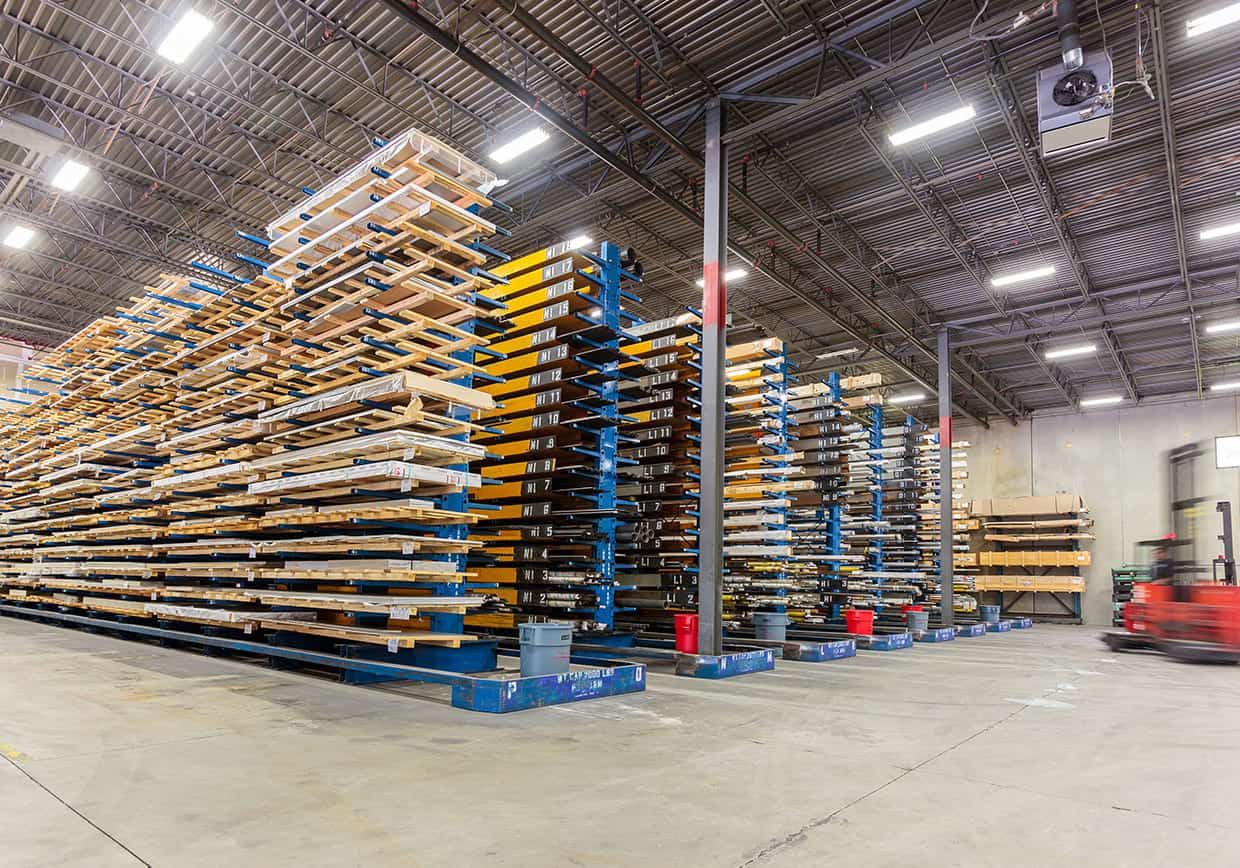
Every warehouse manager knows the feeling: labor costs climb, damaged inventory piles up, and nobody can pinpoint exactly why. Often the answer is sitting in plain sight: the storage system itself. Material handling costs come from wages and fuel, but also from how much walking, lifting, and re-stacking your team does because the racking wasn’t designed for how the warehouse actually operates. McKinsey research found that most operations leaders can’t say what their lowest achievable costs actually are, because there’s no clear method for tracking them. Before you patch together another DIY fix, it’s worth looking at where those costs come from and what a properly designed system actually saves.
What’s Actually Driving Up Your Material Handling Costs
Most facilities don’t lose money in one obvious place. Cost overruns add up in small inefficiencies that repeat hundreds of times a day. A picker who has to walk an extra 15 feet per pull because fast-moving SKUs sit in the back. A forklift operator who slows down navigating aisles that are too narrow for the load size. Pallets stacked two high because the racking wasn’t rated for a third tier, even though the ceiling clearance allows for it.
None of these show up as a line item. Instead, they surface as higher labor hours per unit shipped, more damaged product, and a warehouse that feels busy without being productive. Add in the overtime hours needed to hit shipping deadlines because the layout slows everyone down, and the real number is often much higher than what shows up on a P&L under “racking and shelving.” That’s what rising material handling costs actually look like: not one bad decision, but dozens of small ones baked into the layout.
The Hidden Costs of DIY Storage Setups
DIY racking and shelving look like the cheaper option on day one. The upfront number is lower, and the install feels straightforward. The costs show up later, in ways that are easy to miss until they’ve already added up:
- Racking rated for the wrong load weight either wastes vertical space out of caution or creates a real safety hazard.
- Generic layouts don’t account for which products move fastest, so pickers end up walking farther than they need to, every shift.
- Sizing a system only for today’s inventory usually means a retrofit, and the downtime that comes with it, the moment volume increases.
None of this is a failure of effort. It’s a predictable result of designing storage without the data and experience professional engineering brings to a layout decision. The team that builds the system on a weekend usually isn’t the same team that has to work around it every day for the next five years.
Where Professional Storage Design Pays for Itself
A layout built around actual pick frequency, pallet flow, and SKU velocity changes the math. Fast-moving products sit closer to shipping. Aisle widths match the equipment that runs through them. Racking height uses the full clearance available instead of leaving it unused. Every one of those decisions removes seconds from a task that happens dozens of times a day, and seconds compound fast across a full shift.
This is the kind of reconfiguration work that shows up directly in warehouse projects we’ve completed across Texas facilities, where a redesigned layout paid for itself within the first year through labor savings alone. That upfront design cost pays for itself by keeping the ongoing cost of running that storage from creeping upward every year.
Calculating the ROI: Professional Storage vs. DIY
Put the two side by side and the comparison gets clearer:
| Factor | DIY Setup | Professional Design |
|---|---|---|
| Upfront cost | Lower | Higher |
| Labor cost per unit moved | Higher, ongoing | Lower, ongoing |
| Product damage rate | Higher | Lower |
| Room to scale | Limited, often requires retrofit | Built in from the start |
Run the numbers over three to five years rather than day one, and the upfront savings from a DIY setup rarely hold up against the ongoing labor and damage costs it creates.
What to Look for in a Storage Partner
Some companies will sell you shelving. Look for a partner who can design and install and support racking systems based on how your warehouse actually moves product, not a generic layout pulled from a catalog. That includes planning for future volume, not just current inventory, so you’re not back at square one in eighteen months.
Start With an Honest Look at Your Layout
Material handling costs rarely come from one bad decision. They come from a storage system that was never designed for the way your warehouse actually works. Get a warehouse layout assessment and find out what a properly designed system could save.